I am learning flutter from JustAcademy, They provide very much great environment where people gather and work simultaneously. totally project based training institute.
MOHD ABU BAKAR ANSARI
Flutter Developer
Awesome Experience. I am a Front-end Web Designer working at Star India for 3 years now. I applied for Full-stack development and my experience has been phenomenal & they really do help with placements exceptionally. Thank you Roshan sir so much.
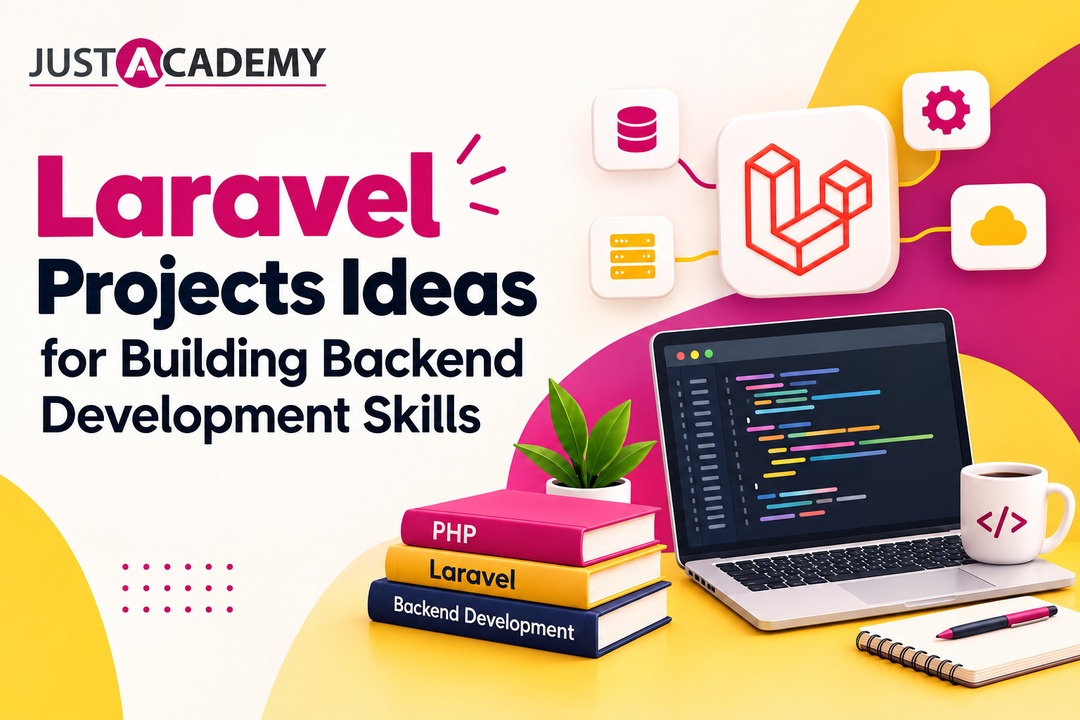
From your very first Laravel build to client ready applications, a Delhi learner’s guide to growing real backend skills through live interactive, instructor led and mentor led practice.
If you have spent any time around the Delhi NCR developer crowd, from the coaching lanes of Laxmi Nagar to the glass offices of Gurugram and Noida, you have probably heard the same quiet debate repeat itself over chai. Is php laravel still worth learning, or has everyone moved on to something shinier? The honest answer, after watching how hiring really works, is that Laravel keeps showing up in job descriptions, agency proposals and freelance briefs, and the people who get hired are almost never the ones who finished the most tutorials. They are the ones who built something. That is exactly what this guide is about: Laravel projects ideas for building backend development skills, arranged from a humble weekend build to the kind of work that makes an interviewer lean forward in their chair.
A quick word on how we teach this at JustAcademy before we dive in. Our classroom is in Mumbai, but Delhi learners join the same live interactive, instructor led and mentor led sessions online, and you can see how the whole programme is laid out on our Laravel training in Delhi page. If you would rather watch a class before making any decision, you can book a free demo session and sit in on one, no pressure and no sales script.
Everything below is written the way a mentor would explain it across a table: plainly, with some opinions, and with the understanding that you are a busy person who wants to build, not just read. Take what fits your level and ignore the rest for now.
Why Most Delhi Learners Stall After the Tutorials End
The comfortable loop of watching and copying
There is a pattern we see again and again. A learner finishes a long video course, follows every instruction, and ends up with a working demo. It feels wonderful for about a week. Then someone asks them to build a small feature without a video to lean on, and the screen stays blank. Nothing is wrong with the learner. The format simply rewarded copying, not deciding. Real laravel coding is mostly small decisions: where this logic belongs, what this table should be called, how to stop one user from seeing another user’s data. Those decisions only become instinct when you make them yourself, get them wrong, and fix them.
That is why projects matter so much more than another certificate on the wall. A project forces you to meet the awkward questions that tutorials politely skip.
What hiring managers across Delhi NCR actually open first
Ask a hiring manager at a software firm in Noida or a small agency in Saket what they check on a fresher’s application, and the answer is rarely the marks. They open the repository link. They look at whether the commit history tells a believable story, whether the README explains how to run the project, and whether the code looks like it was written by someone who understood it. A tidy, modest application beats a sprawling copy of someone else’s clone every single time.
If you want a deeper picture of the skills and career steps that sit around all this, our Laravel developer roadmap for 2026 walks through the full path, and this article is the hands on companion to it.
Why php and laravel still deserves your attention
PHP quietly powers an enormous share of the web, and Laravel is the php framework laravel developers reach for when they want structure without suffering. Routing, authentication, queues, validation, database migrations and testing all arrive thoughtfully designed. For a beginner, this means you spend your energy learning backend ideas rather than inventing plumbing. For an employer, it means a developer who knows Laravel can usually become productive on a real codebase quickly. Combine that with the steady demand from agencies, startups and every laravel development company that builds websites and web applications for clients, and the case for learning php and laravel together stays strong.
Getting Your Workspace and Mindset Ready Before You Build Anything
The tools that matter on day one
You do not need an expensive machine or a fancy setup. You need PHP installed, Composer for managing packages, a database such as MySQL, a decent code editor, and Git for saving your progress. Many learners lose their first week arguing with local server configuration. Pick one approach, whether that is a bundled local server, a container setup, or Laravel’s own tooling, and stick with it long enough to ship something. Switching tools mid project is the quickest way to stop finishing things.
Set up Git before you write your first route. Even if nobody ever sees the repository, the habit of small, honest commits will make your later work cleaner and your interviews easier.
How to create a Laravel project folder the clean way
When you create a laravel project for the first time, resist the urge to dump everything into a single controller. Use Composer to create project files from the official skeleton, copy the environment example file, generate your application key, and connect the database before anything else. That sequence sounds dull, but it teaches you where configuration lives and why secrets should never be committed. Anyone who wants to create project in laravel properly should treat the environment file like a locked drawer, not a notepad.
Once the skeleton runs, take ten quiet minutes to wander through the folders. Look at routes, app, resources, database and config. You will return to each of them constantly, and knowing their purpose turns the framework from a mystery into a map.
Laravel 10, newer releases and Laravel today
Learners often ask which version to pick. Laravel 10 is still found in plenty of live client projects, so understanding it has real value, while newer releases keep refining the starter experience and defaults. If you are looking at laravel today, the sensible path is to learn on a current stable release, then read the upgrade notes for the one before it, because that is exactly the situation you will face at work. Companies rarely run the newest version everywhere. They run whatever was stable when the project began, and they expect you to cope with both.
The core ideas, meaning routing, Eloquent, Blade, middleware and validation, carry across versions with only small changes. Focus on those and the version number becomes a footnote.
Habits that separate finishers from starters
Before the ideas begin, a few habits are worth adopting. Decide on a definition of done for every project, for example "a stranger can register, use the main feature and log out without help." Write that sentence at the top of your README and treat it as the finish line. Work in small slices, merging something that runs every few days instead of disappearing for a month. Keep a short notes file with the bugs you fixed and why they happened. Six weeks later, that file becomes a personal textbook written in your own words, and it is wonderfully useful before interviews.
Finally, give yourself permission to build ugly first. Many learners spend days choosing colours for a project that does not yet save a record. Make it work, then make it tidy, then make it pretty. That order will save you more time than any shortcut.
Starter Builds That Make Your Laravel First Project Count
A personal blog with html laravel and css laravel templates
Your laravel first project should be small enough to finish in a fortnight and real enough to put on a link. A personal blog is perfect. You will write posts, store them, show them on a listing page and open each one on its own page. Along the way you meet Blade templates, which is where html laravel and css laravel finally meet. Build one layout file, pull in partials for the header and footer, and style it by hand before you reach for a framework. That small act teaches you how a backend hands data to a template, which is the beating heart of every website.
Add an admin page protected by login so only you can publish. Suddenly a decorative project becomes a lesson in authentication and authorisation.
A task tracker that teaches authentication
A simple task tracker sounds boring until you realise how much it teaches. Every user should see only their own tasks. That single requirement introduces relationships between users and tasks, route protection, policies and form validation. Add due dates and a status field, then try filtering by status. You will write your first meaningful queries without noticing you are learning query building.
Take your time with the validation messages and the empty states. Polishing the small details is what makes a beginner’s work feel like someone cared, and interviewers notice that care faster than they notice clever code.
A URL shortener that quietly teaches routing and databases
Here is a project people underestimate. A URL shortener needs a form, a unique code generator, a redirect route and a click counter. It looks tiny, yet it covers dynamic routes, database indexing, uniqueness checks and basic analytics. Try adding expiry dates and a simple report page showing the most visited links. You will also have to think about what happens when someone submits a bad address or tries to abuse the tool, which is how security thinking begins.
If you finish these three builds properly, you will understand more about laravel web development than many people who have watched forty hours of video. Keep them small, keep them tidy and keep them online.
Small features that teach big ideas
Do not underestimate the humble extras you can add to any starter build. A search box teaches you about query scopes and how to keep controllers slim. Pagination teaches you how large datasets behave. A simple image upload introduces storage, file validation and the difference between public and private files. Soft deletes make you think about whether data should ever truly disappear. Each of these features takes an afternoon, yet each one appears in real production code every single day.
Pick one new feature per week and bolt it onto a project you already understand. Learning in small additions, on familiar ground, is far less stressful than starting something huge from scratch.
Laravel Backend Projects That Teach You to Think in Data
A library management system and the joy of relationships
Once the starters are behind you, move to laravel backend projects that force you to model messy reality. A library system has books, authors, members, loans, fines and reservations. Books belong to many authors. Members borrow many books over time. A loan has a due date and might be overdue. Drawing the database on paper before you write a migration is the most valuable habit you can build here. Eloquent relationships such as one to many and many to many will stop feeling abstract the moment you have to fetch every overdue book for a particular member.
Add search, pagination and a monthly report. These are exactly the features real internal tools ask for, and they teach you to keep queries efficient as the data grows.
A clinic appointment booking application
Appointment systems are wonderful teachers because time is awkward. Doctors have working hours, slots can overlap, patients cancel, and two people should never grab the same slot. Solving double booking will push you into database transactions and validation rules that go beyond checking whether a field is filled. Add email confirmations through queues so the page does not hang while messages are sent, and you have touched background jobs too.
Think about roles early. A receptionist, a doctor and a patient should see different screens. Role handling is a theme you will meet in nearly every real laravel application, so practising it here pays off later.
An inventory and billing tool for a local shop
Walk through any market in Delhi and you will find shopkeepers keeping stock in notebooks. An inventory and billing tool is a project with an actual audience. Products, suppliers, stock movements, invoices and tax calculations give you a rich schema and plenty of arithmetic to get right. Generate printable invoices, track low stock and export reports to a spreadsheet. If you later want to analyse sales trends, a little scripting helps, and this is where our Python training in Delhi can complement your backend skills, because the same exported data is easy to explore with Python.
Show this build to a friend who owns a shop and ask for feedback. Real users find bugs no tutorial ever will.
A job portal that connects employers and candidates
Another build worth your time is a small job portal. Employers register, post openings and review applicants, while candidates build profiles, upload resumes and apply with a click. It is a delightful project because it naturally contains two kinds of users with different permissions, file storage, search filters and email alerts. You can extend it with saved searches, application statuses and a simple dashboard that shows how many people applied to each opening.
Think about the questions an interviewer might ask while looking at it. How did you stop a candidate from applying twice? What happens to the uploaded resume if an employer deletes a post? Answering those out loud, even to yourself, sharpens your understanding of the code you wrote.
How a Laravel Web Development Company Actually Chooses Its Projects
What a laravel web development company expects from a junior hire
People sometimes imagine that a laravel web development company wants brilliance from a junior. In practice, most want reliability. Can you read an existing codebase without panicking? Can you follow a ticket, make a small change and explain what you did? Can you write a migration that will not destroy production data? Those unglamorous skills matter more than knowing every obscure feature. Laravel developers who last in this industry tend to be curious, careful and clear when they communicate.
When you choose your portfolio projects, pick ones that demonstrate these traits. A project with tests, a readable README and sensible commit messages says far more than a flashy interface.
Scoping a client style laravel website development brief
Try practising on a fictional brief, because real clients rarely hand you tidy requirements. Imagine a small Delhi business wants a laravel website with a product catalogue, enquiry forms, an admin panel and a basic blog. Write down what you will build, what you will leave out, and how long each part might take. That exercise is laravel website development in miniature, and learning to estimate and say no politely is a skill many developers pick up painfully late.
Notice how much of the work is conversation. Writing a one page scope document before coding is a habit that separates trusted professionals from people who disappear when requirements change.
A coaching institute portal as a case study build
Here is a project with a very Delhi flavour. Coaching institutes handle batches, timetables, attendance, fee records, study material and parent communication. Build a portal where an administrator creates batches, teachers mark attendance and students download notes. You will need roles, file uploads, scheduled reminders and dashboards. It might sound large, but you can grow it in layers, starting with batches and students, then attendance, then fees.
Projects like this impress because they mirror what laravel development companies build every week: multi role systems with forms, reports and notifications. If you can explain your design choices for it, you can hold your own in a technical round.
Building a Laravel Project Management System That Feels Like a Real Product
Planning the data model before touching the keyboard
A laravel project management system is arguably the best single portfolio piece for an aspiring backend developer, because everyone in the industry uses tools like it daily. Start with the nouns: users, teams, projects, tasks, comments, attachments and activity logs. Decide how they relate. A project has many tasks, a task has an assignee and many comments, and a user can belong to several teams. Sketch it, argue with the sketch, then write migrations.
Resist adding every feature at once. Ship a version where you can create projects and tasks and move a task between statuses. Only then layer on due dates, priorities, labels and notifications.
Roles, permissions and the packages that save time
Sooner or later you will need an owner, a manager and a viewer to behave differently. This is a good moment to explore laravel best packages without becoming dependent on them. A permissions package, an activity log package and a debugging toolbar can save hours, but you should first understand what they replace. The best laravel developers are not the ones who install the most packages. They are the ones who know why each one earned its place.
Read a package’s source code at least once. Seeing how experienced developers structure their work is a free masterclass, and it will make your own code cleaner.
Why a laravel web development company would value this build
Ask yourself what a laravel web development company sees when it opens this project. It sees data modelling, authorisation, background jobs, real time style notifications, search, filtering and a UI that someone actually has to use. It sees you handled complexity without drowning in it. That combination is what teams hope to find in a hire, and it explains why this single build can carry an entire interview conversation. Even if you only finish about eighty percent of it, you will have stories to tell about the tricky parts, and stories are what interviewers remember.
Pairing Laravel with React Without Getting Lost
Building the laravel api first
Many modern products split the backend and frontend, and a laravel api is the natural bridge. Instead of rendering pages with Blade, your application returns JSON that another client consumes. Start by turning your task tracker or project management system into an API. Learn about resource classes for shaping responses, token based authentication through Sanctum, consistent error formats and sensible status codes. A clean API is a joy to consume, and a messy one is a daily irritation for whoever builds the interface.
Test your endpoints with a tool such as Postman before any frontend exists. If the API makes sense on its own, the interface will come together faster.
Laravel and React project ideas to try
Once the API is stable, pair it with a frontend. A laravel react combination suits dashboards, booking tools and admin panels beautifully. Try a laravel and react project such as a habit tracker, a mini job board, or a kanban board for your project management system. You can use react with laravel in two common ways: as a separate single page app talking to your API, or through Inertia, which lets Laravel routes feed React pages directly. Both are worth experiencing, because different teams choose differently.
People search for php laravel react, react laravel and laravel with react js constantly, and the reason is simple. Employers love developers who understand both sides of a request, from the database query to the button the user clicks. Learning react js and laravel together makes you far more adaptable than knowing either alone, and the same goes for anyone exploring react js with laravel for the first time.
Where your javascript knowledge fits in
React asks for solid JavaScript, and shaky fundamentals will slow you down more than any framework quirk. Promises, array methods, destructuring, modules and fetch requests appear in nearly every component you write. If those still feel wobbly, take a step back and strengthen them first. Our JavaScript training in Delhi is built for exactly that stage, so your React and Laravel work rests on firm ground instead of guesswork.
When you are comfortable, rebuild one older project as a split application. Doing the same idea two ways teaches you the real trade offs, and that comparison alone is a great interview answer.
Smoothing out the small frontend and backend headaches
Every learner who connects a separate frontend to an API meets a few classic irritations. Cross origin requests get blocked until you configure the right settings. Authentication cookies behave differently across domains. Validation errors arrive in a format the frontend does not expect. None of these are signs that you are doing something wrong. They are rites of passage, and each one teaches you how browsers and servers actually talk to each other.
Keep a shared contract in your head, or better in a document: what each endpoint accepts, what it returns and how it reports mistakes. Agreeing on that contract early makes collaboration smoother, whether the person building the interface is a teammate or simply you on another day.
Payments, WhatsApp Alerts and Other Integrations That Make Projects Feel Alive
Adding laravel paypal checkout to a small store
Few things make a project feel real like taking a payment, even in sandbox mode. Build a small ecommerce style store with products, a cart and orders, then add laravel paypal checkout. You will work with an external API, handle redirects and callbacks, and learn why you should never trust the browser to tell you a payment succeeded. Verify the transaction on the server, record it carefully and handle failures gracefully.
Use sandbox credentials only, keep secrets in your environment file, and write down what happens when a payment is cancelled halfway. That written reflection often becomes the best part of your README.
WhatsApp laravel notifications done sensibly
Indian users live on WhatsApp, so whatsapp laravel integrations are a smart addition to a portfolio. Using an official business API or a trusted provider, you can send appointment reminders, order updates or fee alerts. Laravel’s notification system and queues make this tidy: define a notification, choose a channel and let a background worker deal with delivery. You will also bump into real world rules about message templates and consent, which is a healthy lesson in building things responsibly.
Always ask whether a message is actually useful to the recipient. Nobody wants to be spammed, and thoughtful developers design notifications that respect people’s attention.
Laravel no code tools versus real coding
You will meet the phrase laravel no code now and then, usually from tools promising to generate admin panels and forms with barely a line written. These can be wonderfully useful for internal dashboards, and there is no shame in using them to save time. The danger is relying on them before you understand what they generate. Learn the underlying code first, then use generators as accelerators. Developers who understand the layer beneath the tool can debug it when it misbehaves, while those who only click buttons are stuck the moment something unusual happens.
Testing what you build before anyone else does
A project that has never been tested is a rumour, not a product. Laravel ships with excellent testing support, so write feature tests for your core flows, such as registering, logging in, creating a record and failing validation. Beyond that, browser level testing checks what a real user would experience. If you are curious about automation, our Selenium training course is a live online programme that Delhi learners can also follow, and it pairs nicely with backend work because you learn to test the whole journey, not just the code.
Developers who can both build and verify their features are noticeably more valuable to a team, because they ship with confidence.
Putting Your Work Online: Hosting, Domains and Showing It Off
Choosing the best laravel hosting for a learner
A project that lives only on your laptop cannot impress anyone. People often ask for the best laravel hosting, and the truthful answer depends on budget and purpose. Shared hosting is cheap but can be fiddly because Laravel expects its public folder to be the web root. A small virtual server gives you full control and teaches you far more. Managed tools exist that handle server setup, deployments and queues for you, though they cost a little more. For learning, a modest VPS or a beginner friendly platform is plenty, and the process itself is excellent practice.
Whatever you choose, compare backups, SSL support, PHP version options and how easily you can run scheduled tasks. Those details decide how smooth your experience will be.
A calm walk through hosting a laravel project
When you are hosting laravel project files for the first time, follow a repeatable routine. Pull your code onto the server, install dependencies with Composer, set a production environment file with debugging switched off, run migrations carefully, cache configuration and routes, and point the domain at the public directory. Then set permissions on the storage folders and confirm that your queue worker and scheduler are running. Laravel website hosting is far less scary once you have written these steps down and tried them twice.
Practise deploying to a throwaway server before the real one. Breaking something there costs nothing, and the confidence you gain is worth the small effort.
Turning a live laravel website into a portfolio piece
A deployed laravel website is only half a portfolio entry. The other half is the story. Write a short case note for each project explaining the problem, your design choices, the hardest bug you fixed and what you would change next time. Link the live demo and the repository. A small note of caution as well: laravel com is the official site where the documentation lives, so do not confuse your own project’s domain or name with it, and always read the official docs when you are unsure how something works.
Recruiters in Delhi NCR skim quickly. Make your best project obvious, give it screenshots and let the work speak plainly.
Keeping a deployed project healthy
Going live is not the end of the story. Once real visitors arrive, you need to know when something breaks. Learn to read your application logs, set up basic error reporting and schedule database backups. Check that your queue worker restarts after a server reboot, and that scheduled tasks actually run. These small operational habits are exactly what separates someone who builds for fun from someone a team can trust with a live system.
Even a modest personal project benefits from this care. Treating your own work as if people depend on it is the quickest route to thinking like a professional.
Matching Projects to Your Level: A Quick Reference
A comparison of project ideas by difficulty
Here is a simple table to help you decide what to build next. Use it as a guide, not a rulebook, and do not be embarrassed about starting at the top.
Project
Level
Main skills practised
Rough time
Personal blog
Beginner
Routing, Blade, authentication
1 to 2 weeks
Task tracker
Beginner
Relationships, validation, policies
1 to 2 weeks
URL shortener
Beginner
Dynamic routes, indexing, analytics
1 week
Library management
Intermediate
Many to many data, search, reports
3 to 4 weeks
Clinic booking
Intermediate
Transactions, queues, roles
3 to 5 weeks
Inventory and billing
Intermediate
Schema design, invoices, exports
4 weeks
Project management system
Advanced
Permissions, notifications, API design
6 to 8 weeks
Laravel and React dashboard
Advanced
API, Sanctum, frontend integration
5 to 7 weeks
Store with payments
Advanced
Payment gateway, orders, security
5 to 6 weeks
Notice that time estimates shrink when you have a mentor to unblock you. Hours lost to a single confusing error are the quiet killer of learner motivation.
Do certificates matter, and what about certification laravel searches
Plenty of learners search for certification laravel options and wonder whether a certificate will open doors. The fair answer is that a certificate helps a little at screening stage and almost nothing in a technical round. What truly matters is the work you can show and explain. Choose training that gives you guided projects, honest code reviews and a portfolio at the end, with the certificate as a pleasant extra. If you are comparing institutes, our breakdown of the top Laravel training institutes in Mumbai shows what to look for when judging a programme, and most of those questions apply equally to online options for Delhi learners.
Growing a laravel app that keeps up with you
Treat your first laravel app as a living thing rather than a one time exercise. Return to it after two months and refactor. Add tests you skipped. Replace repeated code with a service class. Improve a slow query. A laravel application that evolves tells a more impressive story than five abandoned ones, and it shows the sort of patience that employers desperately want. Many people describe themselves as laravel developers after one project. The ones who earn trust are those who have maintained something over time.
Questions to ask yourself before you pick the next project
When you are unsure what to build, a few honest questions can settle it quickly. Does this project teach me something I cannot yet do? Can I finish a useful version in a few weeks? Will I be proud to explain it to a stranger? Could a real person, a shopkeeper, a teacher or a small business owner, actually use it? If the answer to most of those is yes, start immediately. If you are unsure, shrink the idea until the answers change.
Balance is also worth thinking about. A portfolio of five similar to do style apps shows repetition, not range. Mix a data heavy build, an API with a frontend, an integration with a payment or messaging service, and one deployed application with tests. That spread tells a much richer story about what you can do.
What Live Mentor Led Sessions Change for a Learner in Delhi
Instructor led sessions versus lonely video courses
Recorded videos are patient, but they cannot see your screen, notice your confusion or ask what you meant. An instructor led session is a conversation. You ask why a migration failed, the instructor looks at your actual code and shows you the cause, and you leave with the fix and the reasoning. Live interactive sessions also create a gentle rhythm of accountability. Showing up at a set time, with other learners doing the same, is surprisingly powerful when motivation dips.
For a skill like backend development, where one misplaced line can waste an entire evening, that human feedback loop shortens the path dramatically.
Mentor led code reviews, the part nobody puts on a brochure
Instruction teaches you concepts. Mentoring teaches you taste. A mentor reads your controller and tells you gently that it is doing too much, suggests where validation belongs, and points out the security hole you did not notice. This is the sort of feedback that normally arrives only after months on the job. In mentor led sessions it arrives while you are still learning, which means your habits form well from the start. Having someone experienced review your project management system or your payment flow is worth more than another week of solo struggling.
It also builds your confidence in explaining your own work, which is the skill every interview eventually tests.
Mumbai classroom, Delhi online, same standards
Our offline institute is in Mumbai, and many learners there attend in person for classroom training. If you are in Delhi, you join live online and receive the same curriculum, the same mentors and the same project expectations. People often wonder whether online can really match classroom learning, and we have written an honest comparison of Laravel online course vs offline course that lays out the trade offs without trying to sell you anything. The short version is that interaction quality matters far more than location, and live sessions with real mentors deliver that quality wherever you sit.
JustAcademy is an ISO certified institute, and learners regularly describe our programme as the best course in Mumbai for practical backend skills, with the same live format open to students across India and beyond. Placement support runs alongside the training, covering resume reviews, mock interviews and introductions, so your projects lead somewhere.
A typical week inside a live batch
It helps to picture what a week actually looks like. Early in the week, an instructor introduces a concept, say Eloquent relationships, and builds a small example while you follow along and interrupt with questions. Midweek, you apply the idea to your own project, perhaps adding comments to your task tracker, with a mentor available to look at your screen when something refuses to work. Towards the end, you share what you built, receive feedback on structure and naming, and plan the next slice.
Over a few months, that rhythm of learning, building and reviewing accumulates into real fluency. You are not just consuming content. You are practising the exact loop that professional developers repeat every day, only with kinder deadlines and a patient guide nearby.
Why Structured Training Makes the Difference
Live interactive sessions with a clear learning path
Self study is possible, and plenty of people manage it. But structure saves months. A good programme sequences topics so each one prepares the next, introduces projects at the right difficulty and revisits older ideas when they matter again. Through live interactive sessions, you get to ask questions at the exact moment they arise, which keeps small doubts from turning into large gaps. Instructor led and mentor led practice also means somebody notices when you are stuck before you quietly give up.
Structure is not about rigidity. It is about removing the guesswork so that your effort goes into building rather than wondering what to learn next.
Placement support and a portfolio that speaks for you
The goal of learning Laravel is rarely the learning itself. It is a job, a freelance income or a product of your own. That is why placement support matters. Interview preparation, resume polishing and portfolio guidance turn scattered projects into a coherent story. By the end of a structured course, you should have several deployed applications, readable repositories and the ability to talk through your decisions clearly. Whether you aim to join one of the many laravel development companies hiring across India or work independently as a laravel web developer, that preparation makes the difference between an application that is ignored and one that gets a call back.
If you want to see how this feels in practice, the free demo class is the easiest first step.
Conclusion
Laravel rewards people who build. You now have a ladder of ideas to climb: a blog, a task tracker and a URL shortener to find your footing, then library, clinic and inventory systems to learn how data behaves, then a project management system, a React frontend, payments and WhatsApp alerts to reach client ready territory. Host them, write about them, test them and keep improving them. A few honest, well explained projects will carry you further than any long list of half finished experiments.
If you are in Delhi and want a mentor beside you while you do it, you are welcome to join us. Our live, instructor led and mentor led sessions are open to you online, backed by placement support and the same standards we hold in our Mumbai classroom. Pick the next step that suits you below, and start with project number one this week.
From your very first Laravel build to client ready applications, a Delhi learner’s guide to growing real backend skills through live interactive, instructor led and mentor led practice.
A Delhi focused, mentor backed guide with 40 answered questions, live instructor led practice and a clear path from learner to hired meanstack developer
What Delhi learners and working developers can realistically earn at every stage, and the skills, stack choices and mentor led training that move the number
From your first notes app to a multi tenant SaaS build, here are the MERN stack projects Delhi learners can build with live interactive guidance and show with pride on a resume.
A practical, human guide for Delhi freshers and working professionals who want to walk into every technical, design and HR round with real confidence, backed by live interactive, instructor led and mentor led sessions.
A practical, honest guide to frontend developer skills, the roadmap that actually works, and how live instructor led and mentor led training can get you hired
A practical, no fluff guide to the front end developer skills Delhi employers test for, and how mentor led, live interactive training helps you build them.
Drop us a Query
+91 99871 84296
Available 24x7 for your queries
Want To Connect with us
🚀 Kickstart Your IT Career
with JustAcademy
Learn Industry-Focused Courses with Live Projects & Placement Assistance
Full Stack Java(Java, Spring Boot, Hibernate, REST API, React JS)
Data Analytics(Excel, SQL, Power BI, Python, Tableau)